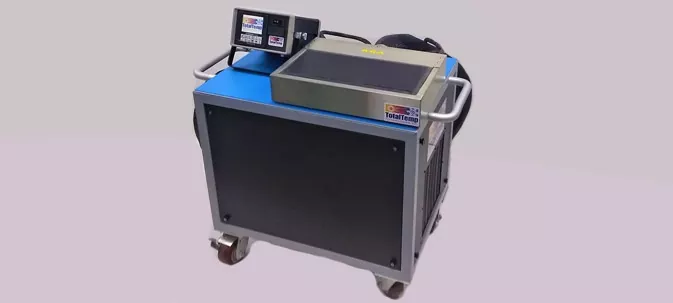
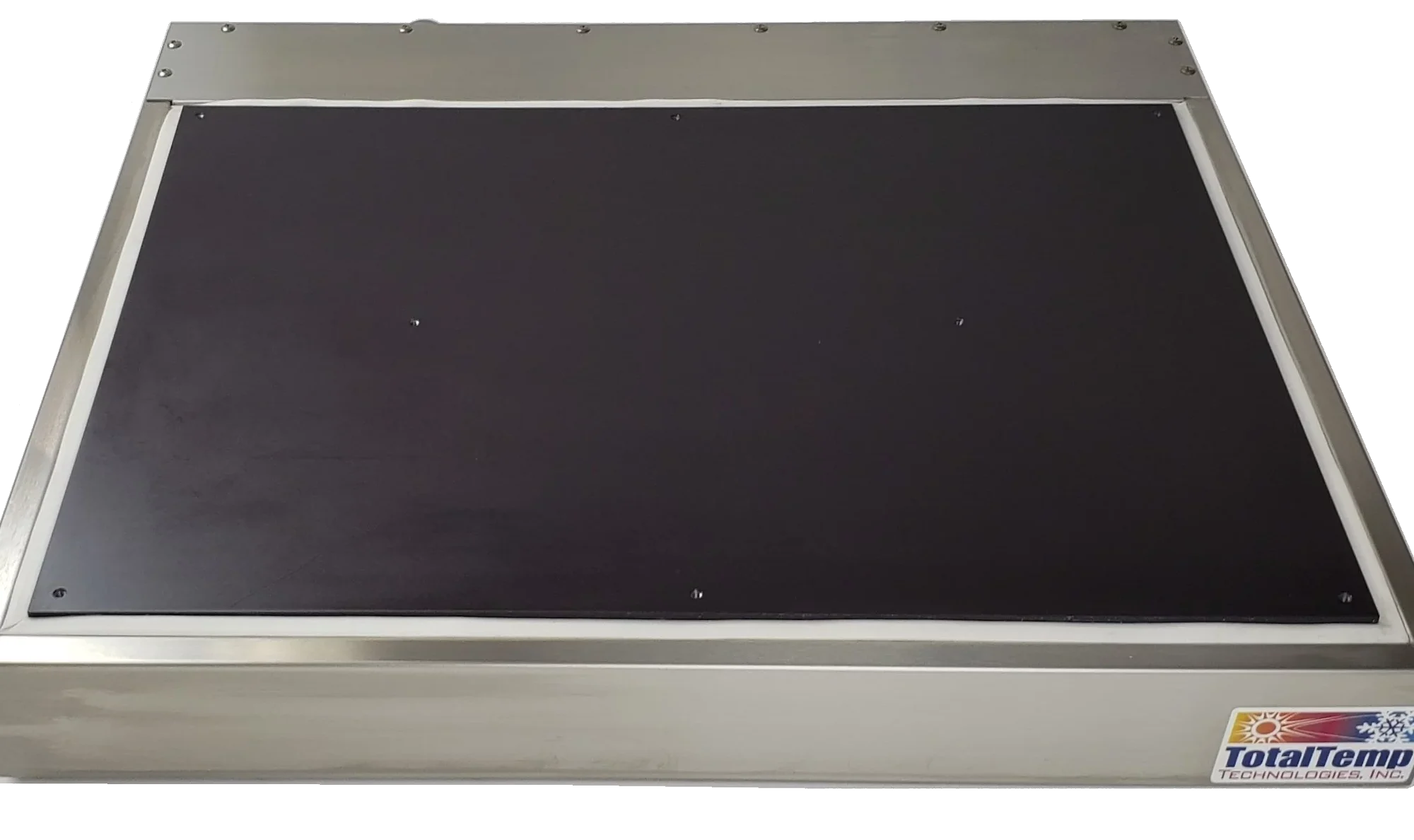
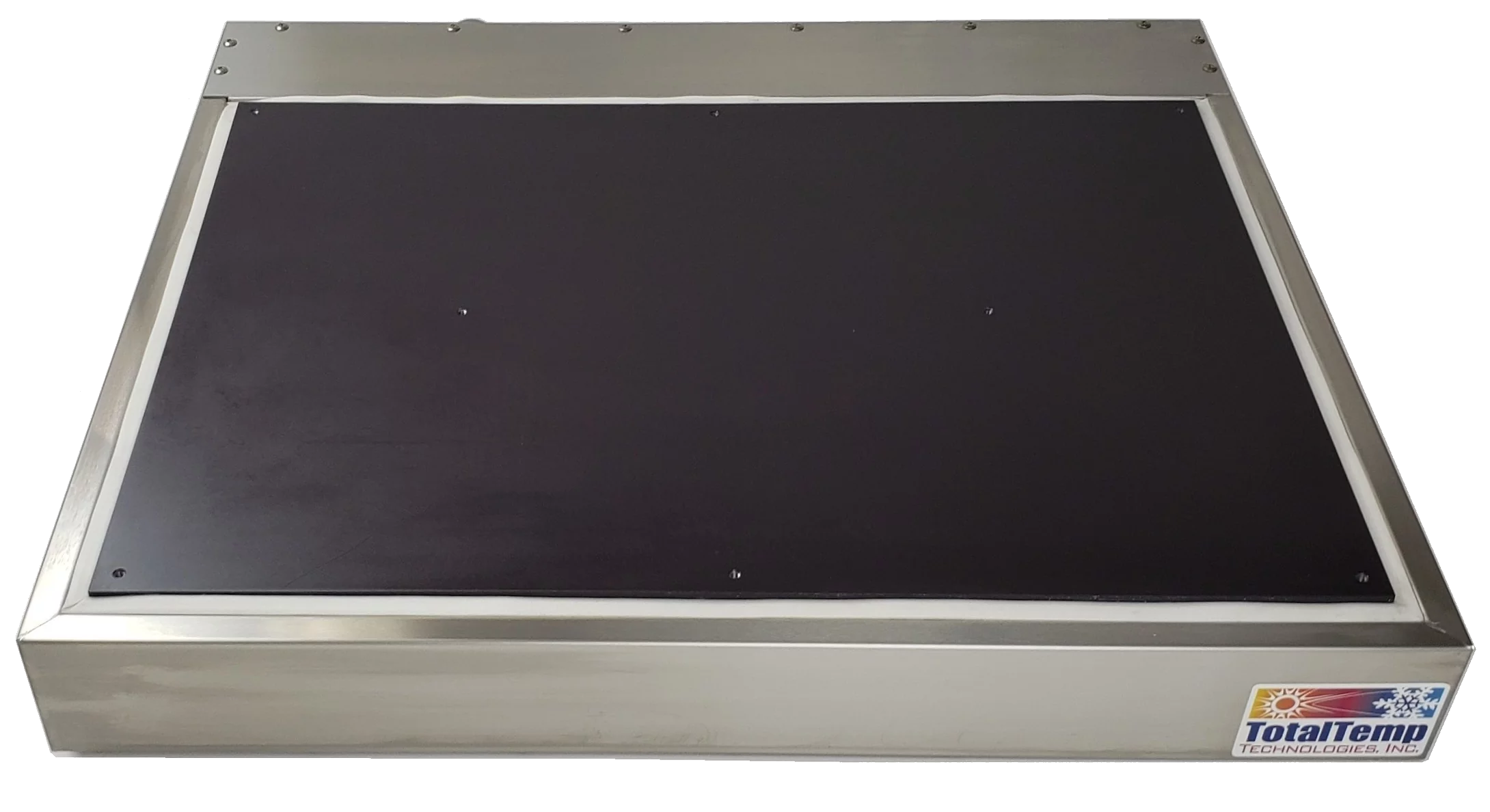
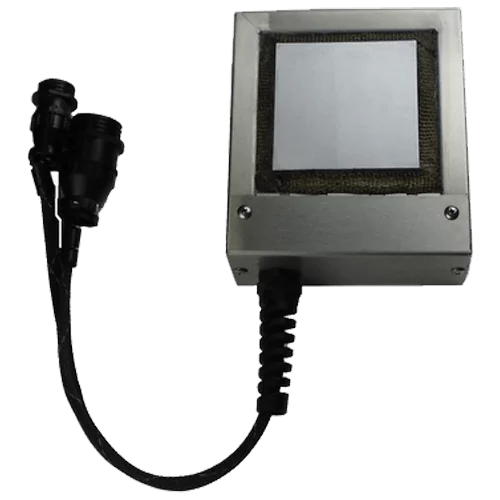
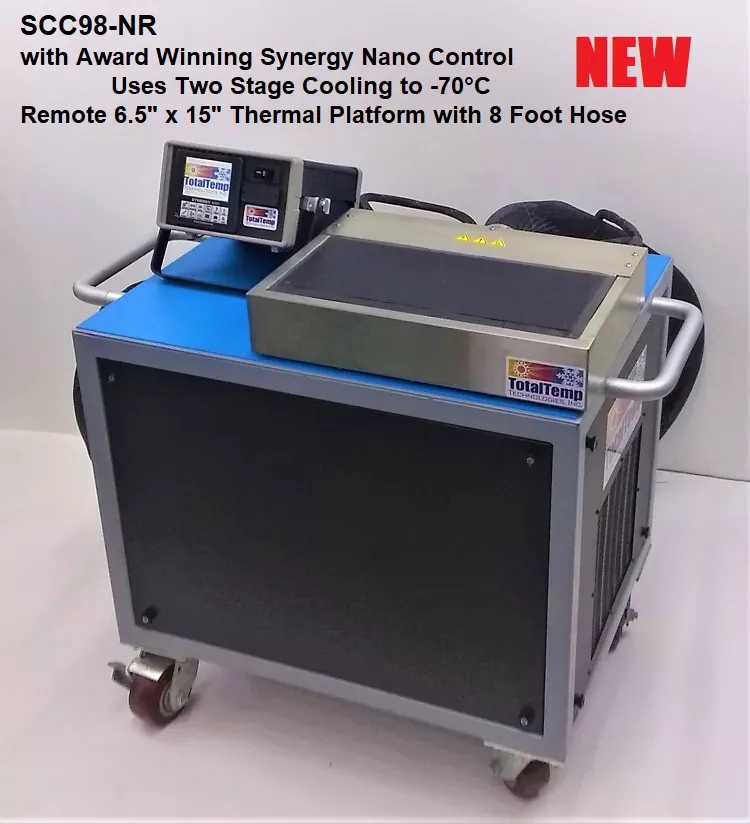
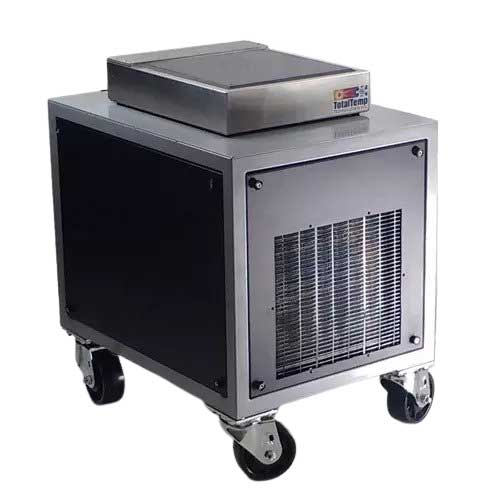
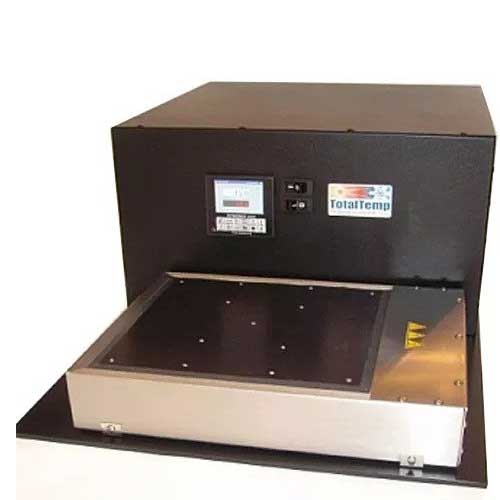
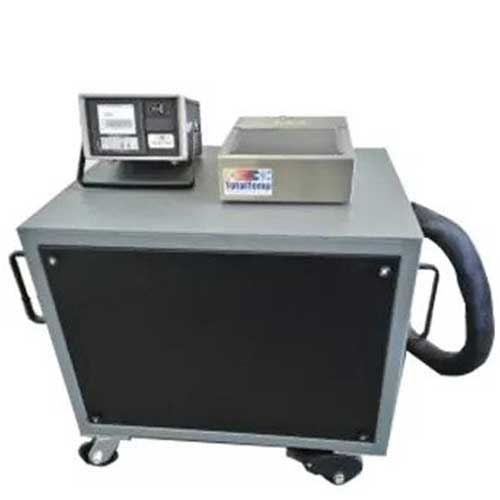
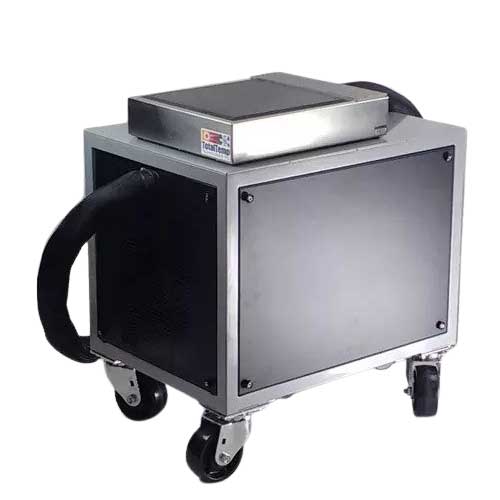
SCC98-NR is a Thermal Platform System for efficient conductive thermal testing. It features an award-winning Synergy Nano programmable temperature controller and a two-year warranty. Alternate sizes and many custom features are available to best meet your requirements.
This platform delivers precisely controlled temperature conditioning to devices that have a flat thermally conductive surface. When using thermal conduction to condition the device at hot and/or cold temperatures, the results are much faster than using thermal convection, as used in environmental chambers.
Some great features this device includes are:
Quickness: It has fast temperature transition rates – comparable to some cryogenic systems.
Efficiency: It is available with a single-stage refrigeration system capable of removing heat at -40°C in less than 8 minutes, while the two-stage refrigeration model can go as low as -70°C.
Nitrogen and Carbon Dioxide free: No L-N2 or L-CO2 tanks are needed and there is no oxygen displacement.
Popular premiere Synergy Controller: It features logging, graphing and flexible compressor configurations, plus Optional Web server, print server, and GPIB communication.
Mobility: It’s available as a fully Benchtop Platform or benchtop platform and controller with an under bench remote refrigeration stand.
TotalTemp Technologies takes pride in fostering innovation with new technologies and continuous improvement, which is why all of our thermal platforms are guaranteed to meet the highest standards for your all-around satisfaction.
TotalTemp Technologies, the new leader in thermal platforms, has been widening its offerings more and more over time.
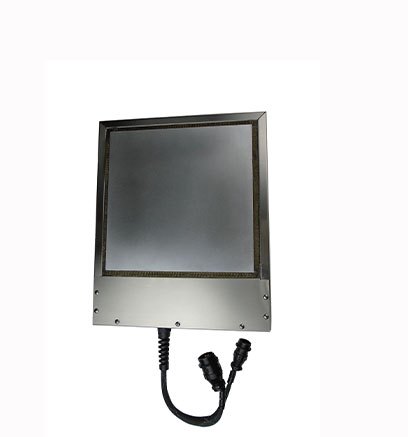
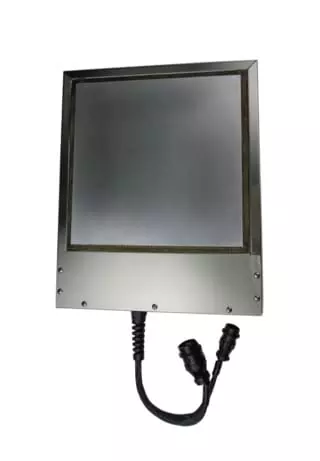
Hot-only Thermal Platforms, these platforms were initially designed for electro-migration solder processes hot-only testing. The new hot-only platforms are available with maximum temperature ranges of 200, 300, 400, and 450°C. Please specify your desired temperature range when ordering. Attractive pricing, safety, and the same flexibility that current hot/cold models have.
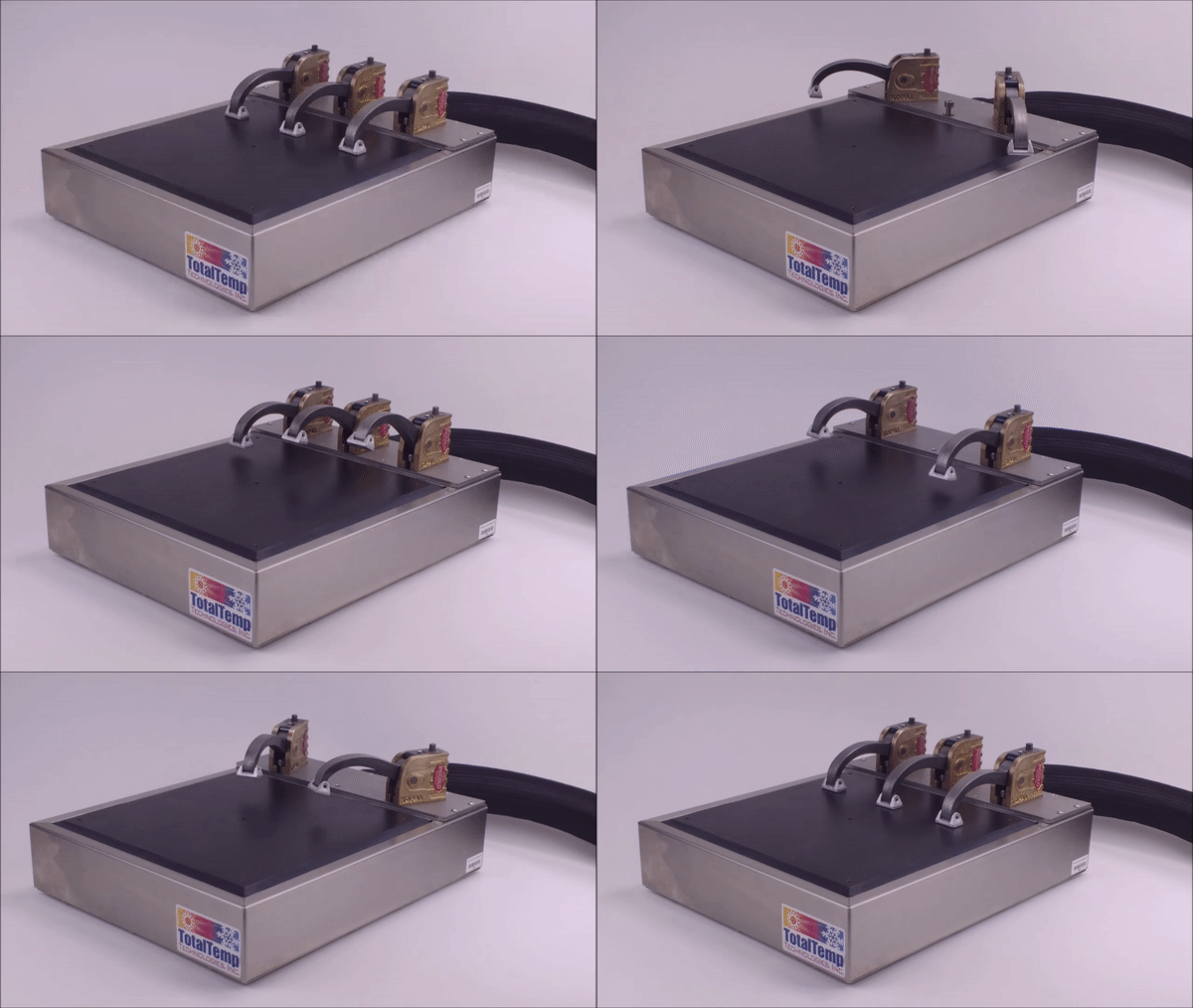
Excellent access to DUT
Extended temperatures range option (400°C shown here)
Efficient conductive heat transfer
Extremely fast temperature transition rates
Hard anodized surface for durability is standard
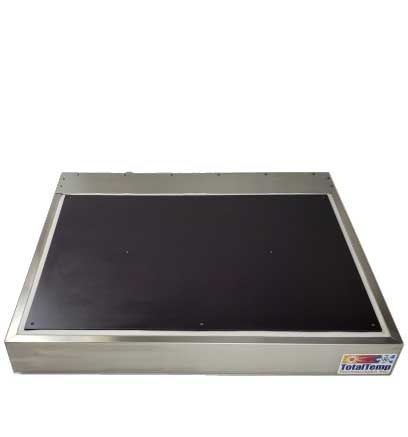
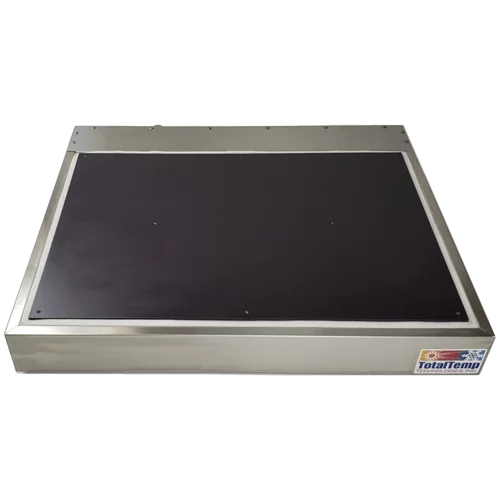
Bare aluminum for electrically conductive surface (shown here)
Five threaded holes are standard
Adapter plates available
Optional no threaded holes and conductive surface (shown here)
Small footprint models for minimal impact on valuable bench space
High accuracy temperature sensors for precise control
Abundant heater arrangement for low surface gradients
Rugged stainless steel chassis
Exclusively designed for easier serviceability, with full access panels
These models carry two-year warranties and can be trusted to meet customers’ expectations.
Model Number
Usable Surface Inch
Usable Surface Milimeter
HSD14
3.75 x 3.75
95.25 x 95.25
HSD49
6.5 x 7.5
165.1 x 190.5
HSD98
6.5 x 15
190.5 x 381
HSD144
12 x 12
304.8 x 304.8
HSD288
12 x 24
304.8 x 609.6
HSD450
18 x 25
457.2 x 635
Email or call us any specific questions regarding hot-only options.
It is well known that test and evaluation of production items is a very important part of producing quality products.
The consequences of a lack of quality are unfortunately well known but covering the bases with appropriate testing can be quite time-consuming and expensive and easily run into the weeds of under testing, over-testing, or testing the wrong condition. The tendency to an error on the side of safety is generally accepted but the flip side of thorough testing can be spending too much time and money testing or literally testing a product to death.
Equally important to understanding the electronic parameters and functions under various electrical conditions which need to be verified is at least a very basic understanding of thermal testing.
A high percentage of failures in electronics are ultimately due to thermal issues.
Subjects for other conversations relating to thermal failures include microscopic cracking, electromigration, the thermal runaway of parameters, or melting of materials. Many electrolytic capacitors have been shown to dry out and fail more quickly at higher temperatures, critical connections can corrode or otherwise deteriorate enough to cause failure. General expansion and contraction along with the associated moisture cycling are often at the root of many failures.
Three ways
As we learned from an engineering background, the three ways temperature can be changed are by conduction, convection, and radiation. In that order, they are generally most effective in use for the thermal tests. Without a big dive into the math and logic behind the statement, conduction is the most effective heat transfer method. Surprisingly, convection, such as in employed in a temperature chamber is far more widely used. As I understand it the main reasons for that disparity are:
1) Heat transfer by conduction requires intimate contact between the heating and cooling equipment (thermal platform) and the device. Fortunately, many device packages for microwave and other power equipment come in a package with a flat thermally conductive surface. Additionally, many other parts can readily have a machined fixture to provide the needed surface contact.
2) The acknowledgment and the ability to cope with the fact there is always some thermal gradient between the temperature driving the equipment and the furthest part from the driving point that needs to be conditioned.
3) Thinking “That is just the way it is done or one size fits all”. Truly, not all items are compatible with a thermal platform however, with a little prior planning work many parts can readily be more effectively tested on a thermal platform or in some cases even using two or more thermal platforms.
Getting the job done
Convection heat transfer can in cases rival conductive heat transfer effectiveness. High airflow is important to heat transfer just with air, just as the clamping force is important to conductive heat transfer. While good airflow is needed for heat transfer, it also comes at a cost. Air friction from high-volume blowers is a surprisingly large source of unintended heating and other losses. It is often seen that temperature chambers designed to maximize heat transfer and minimize test time produce a surprising amount of heat from air friction. For example, a high-performance chamber with strong airflow to maximize heat transfer can be seen to cause the chamber temperature to climb from ambient to over 100°C without any other heat added to the system. Of course, if you are only going that hot, the additional heat from air friction can actually be a benefit. Fighting that heating with a refrigeration compressor system definitely requires a careful recalculation of this heating contribution to achieve expected cooling results not to mention this also adds more heat to the room, eventually adding to the air conditioning load of the lab room. For many applications, a temperature chamber with mechanical refrigeration is a very good choice but before purchasing, we suggest you take time to talk to the professionals at Totaltemp and consider understanding the choices before you buy.
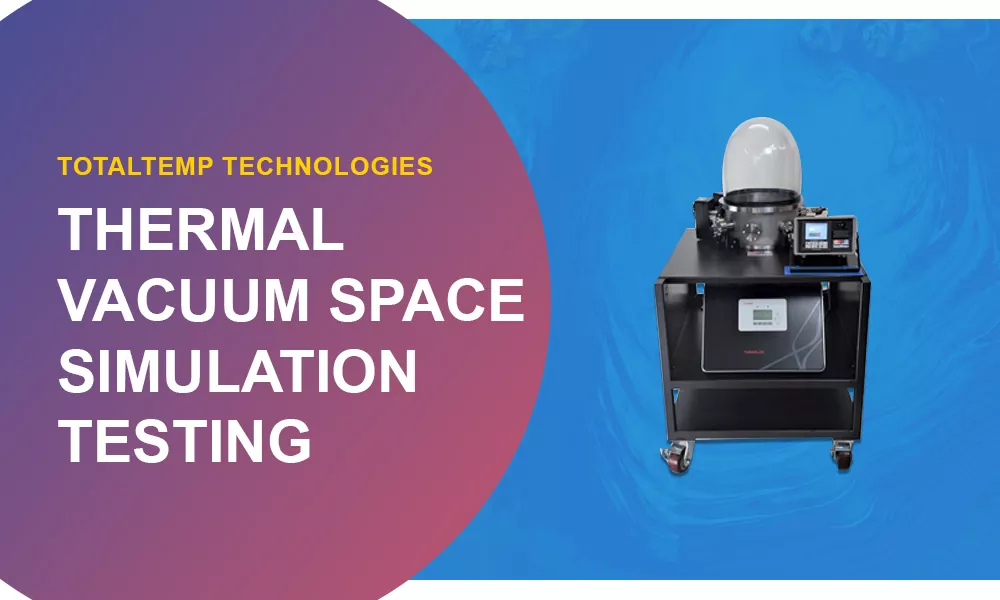
Thermal Vacuum Space Simulation Testing Made Easier
Our space simulation chamber VmSD49-N has been featured in Microwave Journal!
Here is a portion of the article:
“Testing products bound for space is a little different for a few reasons, including the lack of air for heat transfer and general level of criticality, no possible service once deployed plus the general high-stakes nature of the whole endeavor. Taking measured risks for the sake of the advancement of science and technology seems to be a key part of the proposition. Given that, appropriate testing is always important for electronic products, but this is even more true for items that are expected to work in a space environment. “
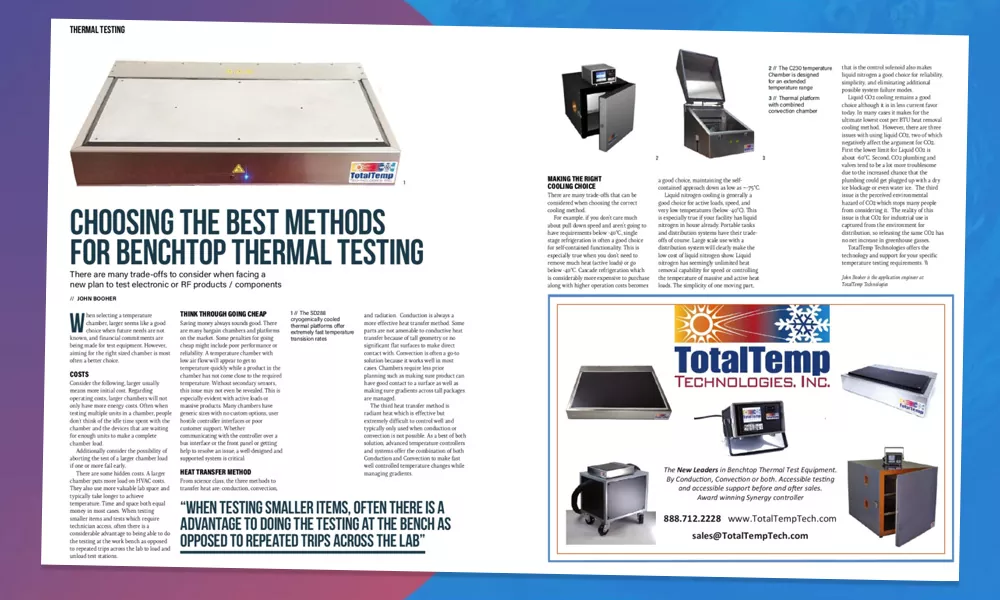
We are happy to inform you that Aerospacetestinginternational.com wrote an article about the best methods for benchtop thermal testing and they are talking about our equipment.
Here is a small portion of the article:
There are many trade-offs to consider when facing a new plan to test electronic or RF products / components.
When selecting a temperature chamber, large seems like a good choice when future needs are not known, and financial commitments are being made for test equipment. However, aiming for the right sized chamber is most often a better choice.
Costs
Consider the following, larger usually means more initial cost. Regarding operation costs, larger chambers will not only have more energy costs. Often when testing multiple units in a chamber, people don’t think of the idle time spent with the chamber and the devices that are waiting for enough units to make a complete chamber load.
How to Pick the Right Thermal Testing Equipment For Your Unique Application
There is not really any one right way. Items that require thermal testing come in a lot of shapes materials and sizes so there is not really one best way to test everything.
If the device has a flat thermally conductive surface or can readily be fixtured to make good conductive contact, chances are a thermal platform is best. Physics tells us that conductive heat transfer works best but when that is not practical to get good surface contact, it is usually best to consider using a chamber or a thermal air stream system.
Also, modern control electronics allows programmability, logging, multi point control, direct network printing alarms including email alerts and much more.
At TotalTemp Technologies we can guide you through all the trade-offs, including cooling methods. We not only design, manufacture and sell some of the best equipment out there but also offer you free dedicated consulting to get you to the best thermal testing equipment that meet your unique requirements.
Call us (888) 712-2228 or contact us if you have any questions.
The Next Generation TotalTemp Mechanically Refrigerated Thermal Platforms are specifically designed for customers who do not have or do not want to use expendable cryogenic coolants and who do not require the fastest hot to cold ramp times. These platforms deliver efficient and precisely controlled temperature conditioning to devices that have a flat thermally conductive surface. When using thermal conduction to condition the device at hot and/or cold temperatures, the results are much faster than using thermal convection, as in environmental chambers.
The unique embedded copper tube cooling channel concept designed by TotalTemp, integrated with a high-density arrangement of long-life durable AC cartridge heaters, provides a comprehensive system able to deliver hot and cold temperature cycling and conditioning on demand. With extremely accurate temperature uniformity and minimal thermal gradients at temperature, TTI has truly created “The Next Generation in Performance” at a price you can handle.
All TotalTemp, single-stage Mechanically Refrigerated products are designed to operate between -40°C and +200°C with a single-stage compressor.
Two-stage systems are designed to achieve -70°C.
Our Refrigerated Thermal Platform systems use commercial off-the-shelf (COTS) ultra-low temperature refrigeration compressor components. The single-stage SC49-N and SC144-N system can cool the 7.5″ x 6.5″ or 12” square surface from +120°C to -40°C in less than 8 minutes. That’s an average of better than 20 degrees per minute for the whole transition from hot to cold.
Cascade refrigeration systems that cool to -70°C are typically a little slower.
The Next Generation TotalTemp Cryogenically Cooled Thermal Platforms
Are specifically designed to deliver fast, efficient, and precisely controlled temperature conditioning to devices that have a flat thermally conductive surface. When using thermal conduction to condition the device at hot and/or cold temperatures, the results are much faster than using thermal convection, as used in environmental chambers. With a faster temperature cycling capacity, the result is a significant increase in production throughput. This not only saves time and money, but the smaller size of a platform over a chamber saves valuable floor and bench space while improving energy efficiency.
The new simpler cryogenic cooling channel concept provided by TotalTemp utilizes COTS technology that is proven and presently in use in diverse markets. Through the successful integration of an embedded copper tube cooling channel with a high-density arrangement of long-life durable AC cartridge heaters, TotalTemp provides a comprehensive system able to deliver hot and cold temperature cycling and conditioning on demand. With extremely accurate temperature uniformity and minimal thermal gradients at temperature, TTI has truly created “The Next Generation in Performance” at a price you can handle!
All TotalTemp products are designed to operate between -100°C and +200°C (-100°C with L-N2, -65°C with L-CO2)